
Understanding SMILE.
The latest advancement in the laser vision correction or near-sightedness and astigmatism, SMall Incision Lenticule Extraction (SMILE) offers the same accurate outcomes and rapid recovery as LASIK, but with additional advantages.

SMILE
SMILE pro
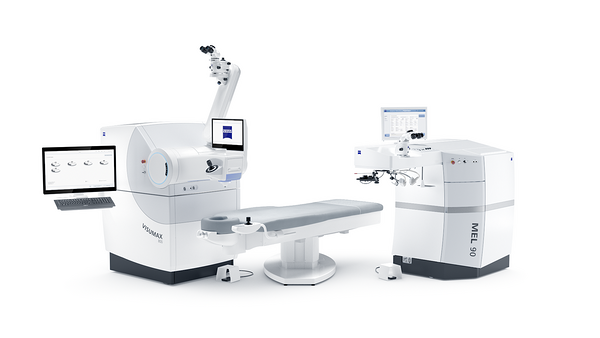
Lumea offers the option of ZEISS VISUMAX 800 for SMILE pro procedures. This technology allows for the creation of the lenticule in under 10 seconds, which reduces the total laser time compared to previous standards. The shortened duration is designed to decrease the time the eye is under suction and pressure, while the ergonomic, open design is intended to assist with patient positioning.
Robotic Assistance and Alignment
The VISUMAX® 800 incorporates robotic assistance features, specifically CentraLign® and OcuLign® technology. These systems are designed to automatically compensate for eye rotation during the procedure. This technology maintains centration and alignment without the need for manual adjustments, which is particularly relevant when treating patients with astigmatism.
Possible Side Effects and Complications
Possible side effects of SMILE are mild and include temporary dry eyes and foreign body sensation. Patients may experience night glare or halos for a few days, which quickly resolves with normal healing. Complications of SMILE are extremely rare and are treatable. These may include infection, swelling, or inflammation.
Ideal candidates for SMILE are:
- Under 45 years of age
- Myopia (near-sightedness) up to -9.0D
- Astigmatism up to 5.0D
- Suitable corneal thickness
- Individuals involved in contact sports
Surgery Length
15 minutes
Anaesthesia
Local with oral sedation
Side Effects
- Dry eyes
- Irritation
- Temporary night glare
Risks
- Infection
- Temporary swelling or inflammation
Recovery
- Discomfort 6‑12 hours
- Vision 1‑2 days
- Exercise 5‑7 days
- Make up 7‑14 days
Final Visual Outcome
- 1‑2 weeks
- Dry eyes typically resolve in 4‑8 weeks
Instructions
- 1‑2 weeks
- Dry eyes typically resolve in 4‑8 weeks